Sunday, October 20, 2013

Savannah National Wildlife Refuge

After the morning at Old Fort Jackson and lunch downtown at a sidewalk cafe, we took our tour in a new direction: The Savannah National Wildlife Refuge. Now, it seems to me that much confusion could be avoided if it were called The Savannah River National Wildlife Refuge. You see, it's named Savannah, but located across the RIVER in South Carolina of all places. I mean, wouldn't you look for something named Savannah in Georgia? I'm just sayin'. . .

In any case, the temperature was mild (by Texas standards), nearly cloud free, and the countryside was very pleasant, if a bit flat. The marshes were extensive and "open water" seemed to invite lily pads. But it's a wildlife refuge and I suspected the lily pads were simply camouflage for 'gators and other things that would "get you" if you wandered too far off the beaten track.

Alert to all forms of wildlife, we came across this butterfly. There were also a few wading birds that seemed to keep their distance from the roadway. The only "wildlife" we saw in abundance were red winged blackbirds. I was really wanting something exciting to shoot, but this seemed to be a bust for wildlife.

This road looked promising, with its deep shadows and Spanish moss. Maybe we'd find snakes or something hanging from the trees as well. . .

Naw, but Darin opened the sun roof and I took a few shots of the canopy. I like the picture okay, but only see the dearth of wildlife.

Finally! A great croc shot - whoops, 'gator shot - and in a Burnt Orange waterway! Making up for the slow beginning, perhaps? Okay, Savannah NWR, I'm mollified.

Here's a smaller one (see the inset for more advantageous lighting), just waiting for an unwary passer-by. Perhaps something plump, with feathers, with stilts for legs. Yeah, that's the ticket. Unfortunately, visitors in general (and this one in particular) seldom have the time or the patience of an alligator to catch a Mutual of Omaha moment.

Having seen a few gators now, I began to appreciate the drive a bit more and realized there was probably a lot more going on right in front of me than I could see. It was certainly a pleasant afternoon drive and we capped it off with a stop on the way home to Leopold's Ice Cream Parlor, downtown. I also picked up a couple bottles of hot sauce for my son in Australia from Wiley's Championship Barbeque. Darin and I had eaten lunch there yesterday and it was, without a doubt, the best barbeque I've ever eaten in my life.

The next morning at 6:00, I departed in the dark headed west for home. I'd originally planned to stop about half way, in Biloxi, but I'd been gone nearly three weeks now and  really wanted to get home. I stopped for a brief nap just east of Defuniak Springs, FL, and that was enough to carry me through some monsoon-like weather in Louisiana and east Texas about sunset. I pulled into Austin just after midnight, and the 2013 East Coast Road Trip was history.  I didn't necessarily replace all the pictures I lost with the computer crash, but I got some new ones to keep me busy for awhile. It was terrific, visiting with those family and friends I got to see, but there were a lot more who were skipped, to my regret. Perhaps I'll be able to catch them on the flip side. . .

Saturday, October 19, 2013

Old Fort Jackson

I had done my homework before the trip and identified Old Fort Jackson as a likely spot for some good pictures. Darin, probably remembering our previous trip to Fort Pulaski, also suggested a visit to Old Fort Jackson. We couldn't both be wrong now, could we?

Smaller than Fort Pulaski, Fort Jackson occupied the single choke point for traffic up the Savannah River to the city. The site had been identified by 1777 and was the location of "The Mud Fort", manned by Captain Lee's artillery unit in the Revolutionary War to fend off the expected British sea-borne attack. Conditions were so unbearable that, when Captain Lee died of malaria, the position was abandoned, even before the British approach. Savannah was easily captured in 1778 and given up by the British shortly before the end of the war.

The masonry fort was authorized by President Thomas Jefferson and building began in 1808 under supervision of Army engineer, Captain William McRee. He was transferred in 1812 and the new fort was garrisoned by US troops and Georgia militia during the war of 1812. The fort was named for James Jackson, a former British subject, who rose to the rank of Colonel in the Continental Army and accepted the surrender of Savannah from the British near the close of the war. He later served as US Representative and Senator, as well as Governor of Georgia. Ongoing improvements were made between the War of 1812 and the Civil War. The fort defended Savannah from Union attack until being abandoned before the arrival of Gen Sherman in December 1864.

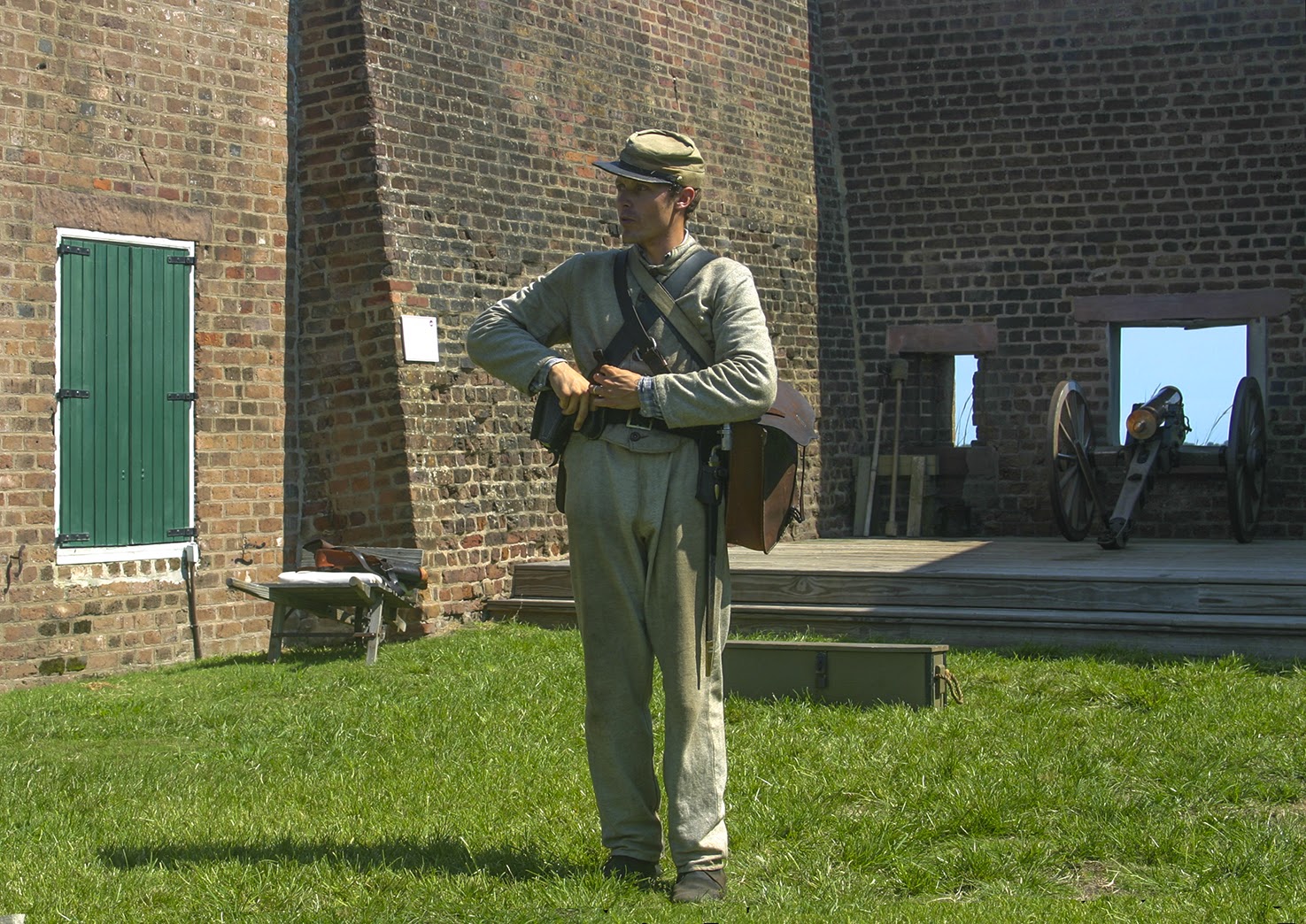
Darin and I explored the fort early, then waited for the scheduled artillery demonstration at mid-morning. We watched young Private Pearson or Pittman or something (sorry, I can't find my notes), CSA, go about his morning business. He was affable, asked where we we from and, when I told him Texas, he responded that General Lee was known to hold Texans in very high regard, having told his entourage, "Texans always move them," [the enemy].

He asked what work we did, and I told him we were both aerospace engineers. Pvt Pullman looked puzzled for a moment (really!) then said, "I heard tell about some fellas floatin' around in hot air baloons. That kind o' stuff?" He stayed in character all morning long. "Yeah, that kind o' stuff," as if I could say anything else.

Pvt Pendleton, still the only person who clearly belonged here, beat "Assembly" from the parapets. Eventually, he attracted, if only loosely assembled, his "troops" - nearly worthless civilians - and began his artillery instruction. He quizzed his charges regularly on the lesson, to make sure they were paying attention.

They descended to the courtyard at Pvt Paxton's command and he continued, the subject now was the field artillery shown, a 12 lb Howitzer or 12 lb Napoleon (I think).

After explaining its uses, Pvt Pinkney addressed ammunition (shot, shell, case, canister, and grapeshot), then hand-picked (drafted) a gun crew from his very inexperienced troops and the gun drill started in earnest.

A pretty sorry lot overall, but Darin (in the red ball cap) stood out as the "shooter" (his honor would be to pull the lanyard, firing the gun). Pvt Pinder kept tight control of his men, insisting that as the engagement progressed, casualties would require the remaining members of the crew to assume the duties of fallen comrades. . .

Just pay attention and follow orders. A typical gun crew could fire once every 30 seconds on average. After the first attempt with his new crew, Pvt Penderghast announced a time of 37 seconds, and averred his belief that they could do better. On their next attempt, the crew took 23 seconds and Pvt Peterson seemed to "choke up" as he allowed as how this was an exceptional improvement. The crew was allowed to be at liberty for the remainder of the day, and the troops were dismissed.

I wish I could remember this young fellow's name. He was excellent in every aspect of his behavior. I guess he should have been; when asked, he said he'd started as a 13 year old drummer boy in 1862. He's learned a lot in 151 years.


Friday, October 18, 2013

Tybee Island, GA

On taking my leave of Charleston I made my way south on US17 to Savannah to visit my friends Darin and Jennie. I worked with Darin at Lockheed before my retirement and his departure for Gulfstream. Jennie works for the Leukemia Society. With both of them still working, Darin was kind enough to provide lodging and take a day and a half off to explore the area with me to boot.

Our first stop for pictures was a city/county fishing pier just beyond the Lazaretto Creek Boat Ramp where old Highway 80 crossed the creek. Opposite the pier, on the east side of the creek, are a couple of marinas. I don't know how much business they do, but the boats left at the dock are always good for several shots. The bridge in the background carries the Islands Expressway/US80 traffic to Tybee Island.

The Lazaretto Creek Marina is the southernmost of those clumped opposite the pier. The various channels within a mile or so form a veritable maze. Though this one is most likely Lazaretto Creek, Google Maps has it labeled the Wilmington River. In any case, the marinas are on Tybee Island, which means there's another lighthouse nearby.

Last time I visited, in 2010, I got some good pictures from Fisherman's Walk, but Darin wanted me to see the village Pavilion and fishing pier. The high winds promised lots of wave action at the beach and we weren't disappointed.

While the OBX wading birds were holed up in Charleston, I discovered the pelicans had come all the way to Savannah. These six were practicing low level tactics among the waves. Ask an A-6 or F-111 driver and you'll find terrain following takes intense concentration, and a great terrain following radar (TFR) helps a lot. These pelicans do it with the obstacles constantly moving! Okay, they're not doing it at a few hundred knots, but still. . .

Finally! The payoff: Tybee Island Light, with the most beautiful lines of any lighthouse I've seen or heard tell of. And, to top it off (literally), a fantastically dramatic sky-full of clouds.