Wednesday, April 11, 2012

Texas 71 -- Between Llano and Fredonia

Most of the pictures in this post are pretty straightforward; they celebrate being "on the road again" as Willie might style it. The morning sun speaks to the prospect of a good day's drive. This section of the trip lies along Texas Highway 71 between Llano and Freedonia. I stopped at one of the ubiquitous historical markers along the way and learned that Valley Spring (est. in 1878) combined the towns of Whistleville and Bugscuffle, which had grown up after O C J Phillips first settled there in 1853. It was also the birthplace of James Field Smathers (1888-1967), inventor of the electric typewriter.

I like everything about this picture except the telephone pole and the lines strung behind the Mesquite trees. It's like hearing a song on the radio that you haven't heard or 30 or 40 years; it just makes you feel good.

The warm glow of the sun and the shadows reaching across the highway are rewards for getting out of the house before the sunrise.

This is as fine an example of a Mesquite as you'll ever come across. I could have framed it a little bit better, but I couldn't have made it any prettier. I'd never thought much of Mesquite before this past week. I studied up on it (to make sure I had correctly identified it) and came away much more respectful.

I was glad to include this straight section of highway when I compose this shot. The flowers, of course, are the main focus, but this highway heads to San Angelo; it makes me think of Kim and Robert on their ranch.

Another good thing about shooting so early in the morning it's that there's seldom much of a breeze, so your subjects stand still for you. I love the sharp focus and even distribution of the bluebonnets in this shot.

 And, just when you wonder where the paintbrushes are, you find a few right where you want them.

I'm not exactly sure what we've got here, other than the bluebonnets. Black-eyed Susans perhaps? And what are those things that are hanging, like tiny strawberries? Again, with no wind, everything is still and every detail is crisp.

Mother and I decided we like our bluebonnets growing from the verge of the road and up, over a bank. Some big rocks or a stand of prickly pear are appropriate there also. I think a coyote staring down at you would add some drama. Even a rattlesnake, coiled up at the base of the bank, wouldn't be out of place. But the picture works even without the fauna.

I like this big oak tree on the bank. A similar one we encountered last week reminded mother that her father, Austin, always used to keep an eye out for a good shade tree next to the road where he could rest his team of horses. He'd unhitch them, figuring they could rest for 20 minutes or so and still get home before anyone came looking for him.

Tuesday, April 10, 2012

Sunrise Along Texas Highway 29

I returned home from my nine-hour tour Saturday with hundreds of new images. The twin blessings of digital photography and multi gigabyte compact flash cards are manifest. It allows one to shoot whatever strikes his fancy at the moment, but that puts off a lot of decisions till later. Some might argue that an effective photographer should be making many of the technical decisions at the scene, rather than deferring them. I, on the other hand, prefer to "shoot 'em up" and sort it all out later. I like to take advantage of the enthusiasm that reigns when you concentrate on framing, focusing, and shooting.

Coming back with a large haul of pictures, of course, means that you will have (hopefully) more good ones from which to choose and, if you don't have an arbitrary limit on the number of images or a hard schedule, that's a good thing. Additionally, when you find yourself with time on your hands, sorting the images, composing them through judicious cropping, and performing the many other post-processing tasks that may occur to you aren't really "work", but a pleasant way of spending your time that will yield a tangible, pleasing result.

Saturday's drive started an hour before sunrise and I took the first picture several miles west of Lake Buchanan on Texas 29. Silhouettes have their place if the composition is right, probably because it's difficult for some of us to judge the early morning or late evening light. It goes back to the reason for HDR photography: the human eye is a better sensor with a wider range than the sensors in the best cameras.

You probably wouldn't guess it from my sleeping habits these days, but I'm a morning person. I've enjoyed the sunrise in all of the best Mediterranean ports, and not only because I may have had a buzz on after a night on liberty. To my eye, the quality of the light is usually better than it will be all day; there are fewer people (usually distractions) out and about, which leaves you with the feeling that this is your morning, to share or not through your images with the laggards still in bed.

The benefits of the early morning are their own reward. I can look at this picture and remember the cool breeze, the dew on the bluebonnets, and imagine the smell of fresh-cut grass. I imagine that because, when the wildflowers are at their peak, it's hard to find anybody that will cut the grass on the side of the road.

In general, I think I prefer my awe inspiring vistas or even simple landscapes without overt evidence of mankind's having been there. Occasionally, an empty road or a distant car coming or going might add something; likewise, a farmhouse or barn, properly understated, might suggest a story for the scene. But I really like fences and gates. It doesn't matter what style they are, whether they're in good repair or ramshackle. The gates may be open or closed; it may change the story, but otherwise it's of no import. And they're almost always just right, appropriate.

Here, I'm shooting over the gate and thinking how "cool" the pasture is and how "warm" the red dirt road is. For your edification, if one hadn't the foresight to use auto-exposure bracketing and a plan, there is a method for creating HDR photos from a single picture. It's best done using a "raw" image rather than a JPEG, but that usually requires some foresight as well. You take the single image and change the exposure at least twice after-the-fact to get an underexposure and an overexposure to go with the properly exposed image you started with. The usual HDR processing can then often come up with the expected improvement. In both of the "road" pictures above, I used this method to get an acceptable sky.


All day long the roadside wildflowers were beautiful, especially so along Texas 29.


By this time, you've probably surmised that this is an HDR picture. It is, but with a difference or two. For some reason I haven't yet discerned, the blown out sky of the original did not yield an HDR improvement. So I replaced it with the pale blue gradient I've used before. But, while I was doing that, I thought, "Why don't I import an appropriate sky instead of creating one?" This sky was imported from the Triple R Ranch, west of San Angelo. It's not perfect, but it worked pretty well. I was pleased with the result and wanted to keep going. The admittedly almost cartoonish quality of the scene suggested that perhaps I needed to include the Easter Bunny in the foreground. I found some hares in my files (these would be Georgia hares), selected one, and presto! But while I was looking for the rabbits, I also found some Georgia whitetail deer. . .

You see where this is going, right? I also have chipmunks, squirrels, lots of turkeys, sea gulls, turkey buzzards, a blurry fox and a pileated woodpecker in my files. Luckily, I came to my senses and went to bed.

Sunday, April 8, 2012

A Little Farther Afield

Yesterday was a great day! While I was working over the pictures and blog posts for the Bluebonnet Expedition a few days ago, I decided I needed to go farther afield to find some new locations to shoot. And, with bluebonnets still on my mind, I got into Google Maps and worked out a route for a Hill Country field trip.

I was up at 5 o'clock and out of the house by 6 - yeah, I know - planning to pass by Inks Lake about sunrise. I missed one photo opportunity right off the bat when I looked up and saw the full moon working its way the western horizon. Alas, by the time it was ready to set and I could pull over to get a shot or two, it was obscured by clouds. Oh, well.

I got back to the apartment about 3 o'clock (in time to watch the third round of the Masters), filed the hundreds of images I'd brought home, and began to work on them. This post is going to be a comparison of three subjects I happened on yesterday; three subjects that I shot with both the "big" Canon (the first of each of the sets) and the "little" Canon (the second). Of course, that also means three regular images and three HDR pictures.

Please keep in mind that I'm still learning (every day) things about both photography methods and post-processing tools, so none of us has to love everything about any or all of these shots. Hopefully, there's something in each of them that you do like.

One of the biggest problems for a roadside photographer like myself is finding a place to pull over when you see a subject you'd like to shoot. Sometimes, you find a likely spot with but little of interest, once you've checked it out. But occasionally you find a surprise,  and this time I pulled off for the Bluebonnets I could see from the highway and found this serendipitous barn. The composition was easy, with the Oaks and Mesquites and, of course, the Bluebonnets. My biggest problem with this picture is the blown out sky. I'm facing east and the clouds between me and the sun can do nothing but defuse the light. How nice it would be to have a Carolina blue sky scattered with cotton clouds.

I still have a problem with the sky in this HDR image, but at least there's something here to add interest, even if I haven't yet mastered the tools that would make this a "great" shot. I like the low camera angle; I used the tripod without extending the legs and could frame the picture because the little camera has an articulated LCD. (Pictures taken with the big camera are basically shot from whatever level my head happens to be.)

This next pair of shots was taken at the same roadside stop, only a few steps from where I shot the old barn. In the picture above, the sky was completely blown out so I gave it a pale blue gradient sky after-the-fact. I do that occasionally, when the blown out sky annoys me sufficiently. Manipulation of images by photographers has long been controversial, but my position on the matter is that it's a manufactured controversy. Ansel Adams spent a lot more time working each picture in his photo lab than he ever spent with his camera in front of Half Dome or Yosemite Falls. . . I rest my case.

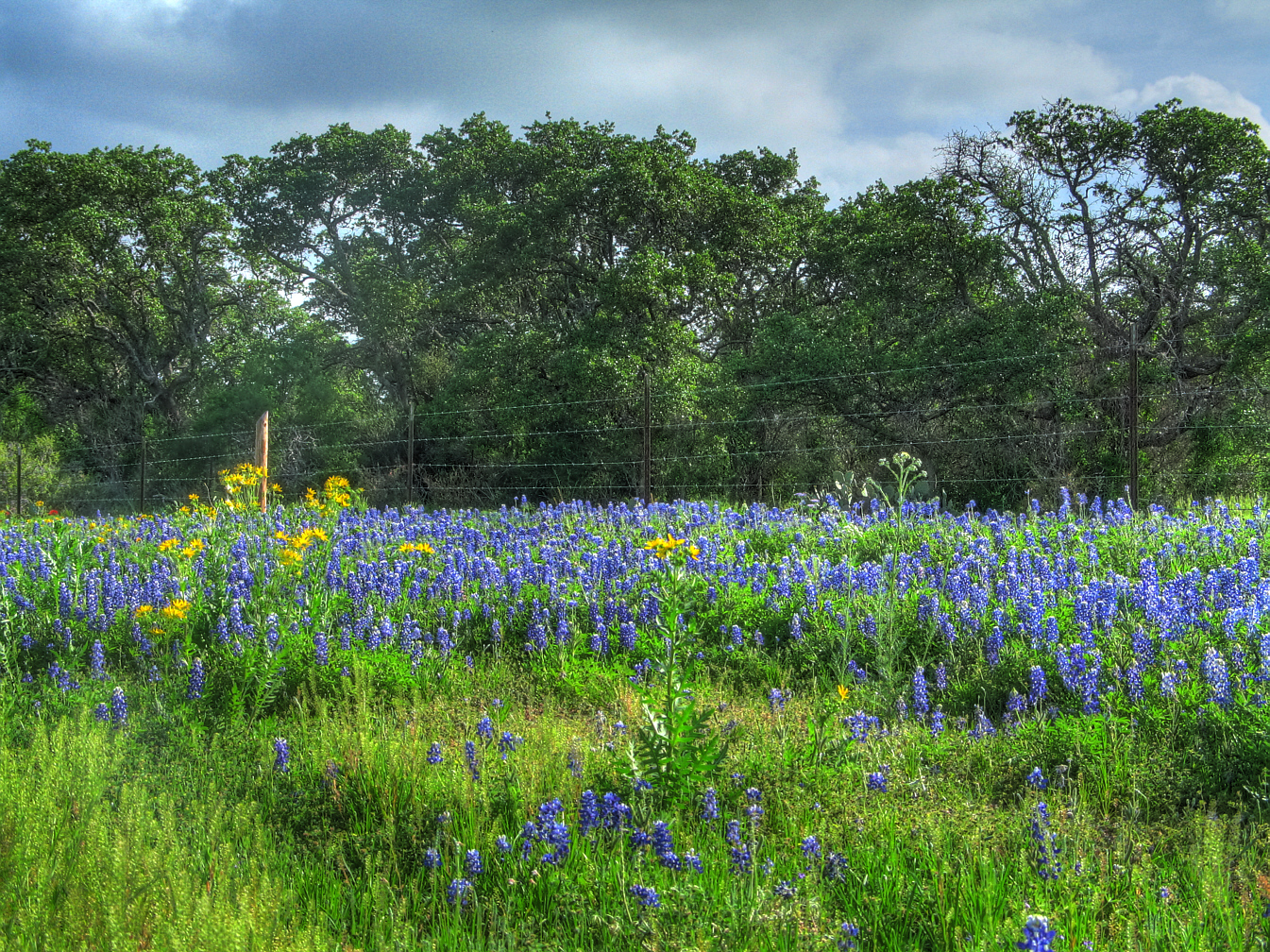
I'm not crazy about the sky in this either - hell, for that matter, I wasn't crazy about the actual sky when I shot the pictures! But what I really like in this shot - besides low camera angle - is the detail in the flowers and every twist of wire on the barbed wire fence. Remember: look for the stuff in each picture that you do like.

This pair of trees, which certainly have seen better days, caught my eye because they stood out so well from their dark green background. Yeah, I fixed the sky, but we already talked about that. The composition of this shot leaves a bit to be desired too, but it was taken towards the end of my 9 hour sojourn and I didn't have the energy or inclination to back up 50 feet (it would've entailed moving my pickup and wading across a creek). I included it in this post because I had a corresponding HDR image with which to compare it.

You may not like the sky in this one (I don't - the color's horrid), but it certainly is dramatic! With some practice, perhaps I'll be able to coax a satisfactory sky out of the elements involved. But again, the detail of the foliage, shadows, and the awesome colors of the lower two thirds of image I find awesome.