The window is closing on 2014's crop of bluebonnets. But at present, I think this one is not as fine as either 2010 or 2012. Of course, they may still not have peaked yet. I fear I must go ahead with my plan for a day-long, far-ranging bluebonnet expedition before the window slams shut. But wait, you say. What about the rest of this drive? Wasn't there anything else to arrest your attention? Oh, yeah. . .
There's always the beauty and promise of an (empty) open road. And, in this case, there are the bluebonnets to consider. If I laid out my course to evaluate the year's crop, aren't I obligated somehow to carry on? There may well be tons of bluebonnets around the next bend, n'est ce que pas?
I'm often amazed by what's around the next corner; however, I am continually surprised by what I find when I drive the other direction on a road for the first time. I've driven Park Rd 4 many times, but never this direction, until Saturday. I was startled by this view looking west, above the junction with FM 2342 to Kingsland. Since we cannot always turn around and check out the scenery from the opposite direction it might help, certainly when we're on a scenic tour, to pay more attention to what's in our rear-view mirrors.
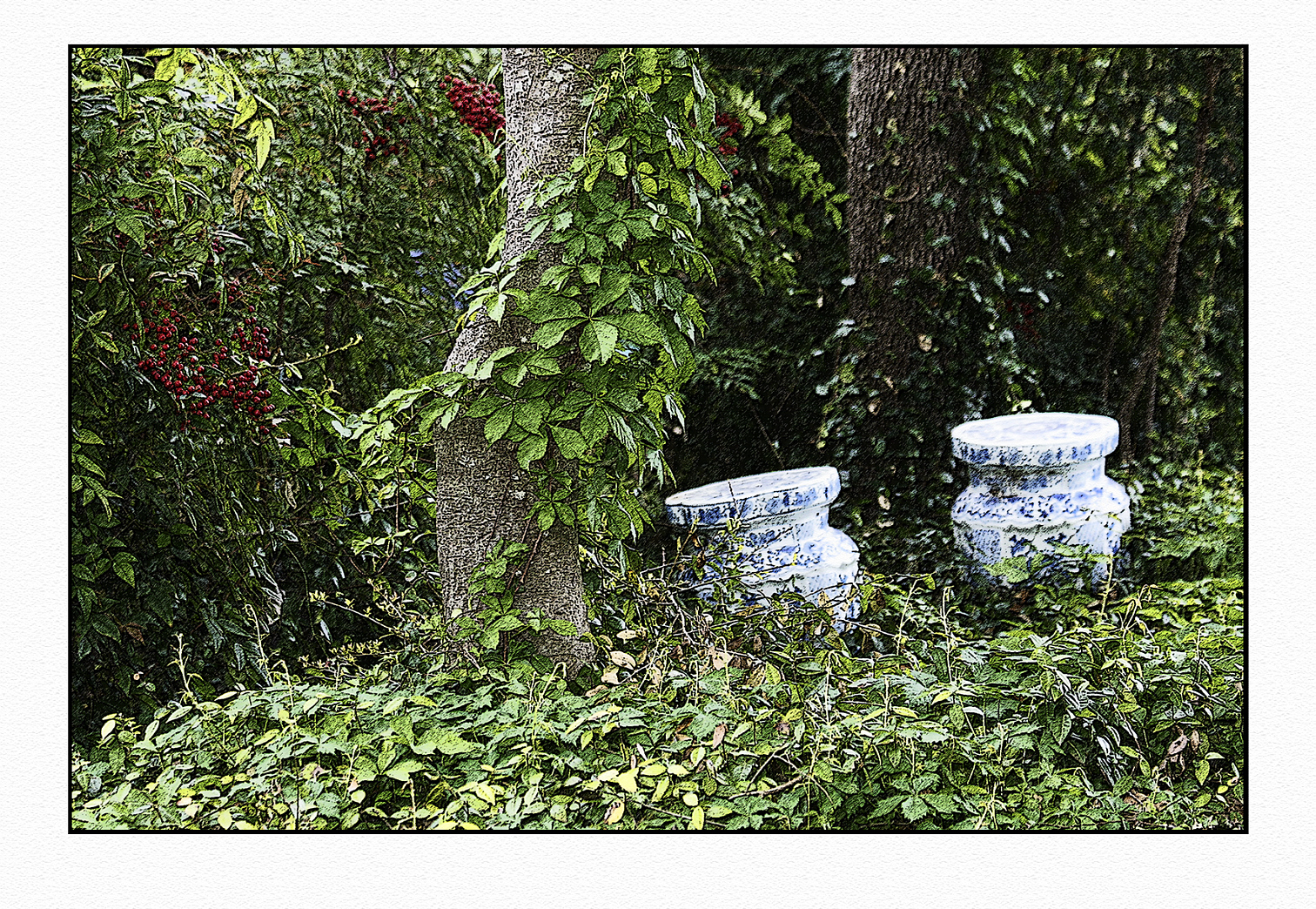
It also helps to change your focus occasionally. In this case, once out of the pickup and having taken the shot of the vista, I was able to look around at the component parts of it's composition. It's hard to conceive of a landscape architect having been at work here on the state's nickle to dress up the view as I came around the corner. And, if he had, could he have done his work any better? This is a beautiful arrangement of component parts! And not a bluebonnet to be seen.
Farther down the road, of course, there were indeed more bluebonnets, with some Indian paintbrush added as a counterpoint. . . maybe not as many in years past, but certainly more than last week when Amy and I passed this way.
By this time I've put things into perspective: shoot what's in front of you (and what's beside you and what's behind you) and enjoy yourself. Pay attention to the bluebonnets for your evaluation, but take the blinders off and appreciate the other things as well.
And what might be or might have been? When you read about bears and wolves in the woods, you're more alert walking through the woods. When your reading includes tales of Comanches roaming the Hill Country, you can't drive down US 281 without imagining a raiding party making tracks under a full moon. And, if you've enjoyed Louis L'Amour and J Frank Dobie, you'd almost certainly see a Longhorn staring back at you from the rocky hillside. This cow is one of Robert & Kim's brought all the way from San Angelo, mirrored and installed right where she should have been if I'd been here looking around for Comanches 150 years ago. See how that works? Reading... imagination... technology... opportunity...
Shake it off, Parker. Ah, there's the lake. Don't forget the evaluation. Some paintbrush and a few bluebonnets - but still more than last week. Yeah, if there are more than last week, which seems to be the case, you need to make that definitive day-long, far-ranging expedition. It may not rival 2012's trip, but I should still see more than I've seen thus far in 2014. And that'll be worth the effort.
A couple miles left on Park Rd 4 till I get to TX 29. Anything left to shoot? Of course! I'm going "the wrong way" after all. What do I see going this direction that I've missed all those other times headed south? Texas has always been a hard land. Look at this tree. Talk about a hard life! Beaten up, mostly dead, but still sending off shoots. Well, whatever it takes to survive. . .
If this post seems somewhat disjointed, I apologize. I've been distracted. Last week I recorded "The Prize" on TCM (I always liked Paul Newman). I started the playback when I started the post. . . since I'd already seen it any number of times it would be "background noise" and I could look up and pay attention when it got to the "good parts". So, everything's going along fine. . . then, "I don't remember that?!! And where is Julie Andrews? And what's Elke Sommer doing in this?" And Edward G Robinson for that matter. It seems that besides having to dig for things that had always been filed close at hand, I'm now mixing up movies, which I hardly ever did before. "The Prize" is not "Torn Curtain", and Paul Newman was getting a Nobel Prize, not attending a conference in Copenhagen. He was a writer in the first and a scientist in the second; he uncovered a plot in the first and snatched a secret formula in the second. I like them both - now - but they shouldn't be confused.
Sharing some favorite pictures, some reminiscences and/or cogent comments about the images with family and friends. Occasionally, I might include someone else's picture to illustrate a point, but I'll let you know when that's the case. As ever, click on an image to view a larger version.
Tuesday, April 15, 2014
Monday, April 14, 2014
2014 Bluebonnet Evaluation
With a serious lack of imagination I drove south out of Austin on Saturday seeking the visual cues that will tell me whether or not the bluebonnets have peaked yet this year. I'd been out to Inks Lake twice already; the first time was in response to reports of beaucoup bluebonnets between here and Bastrop, and the second time was with Amy, my daughter-in-law, when she visited from Australia about 10 days ago. Both excursions were disappointing with respect to bluebonnets west of Austin, but in both cases I needed to get out for a drive or go buggy here in the hermitage.
I also wanted some quality time with my new lens (70-300mm, remember? I told you about it a couple of weeks ago, you just don't remember.) This is the view looking south from "the Pass", a roadcut through a limestone ridge on Ranch Rd 165 between Henley and Blanco. This is the 70mm version.
This, on the other hand, is the 300mm version looking at the same bend in the road, but with more traffic and more wildlife. That's a Turkey Vulture, identifiable by the white underside of the wings' trailing edges. We also do Black Vultures here, but they were on strike or something so they missed the pictures. One of the things that's neat about this lens is that if the sky is ugly or boring on a particular day, it doesn't necessarily have to be in the picture.
Buzzards and vultures are really ugly, up close. Of course, it's not their fault, and they do have redeeming social value. Besides helping out with road kill, they're as graceful as any bird in nature. It's up to us to choose the distance that doesn't embarrass the creature and provides us an aesthetic experience, watching it soar effortlessly over the countryside. The picture above, taken from a bridge on the eastern outskirts of Blanco, emphasizes that vultures aren't the only homely denizens of our skies (or the homeliest) and, for good measure, demonstrates that the ugly duckling doesn't always turn into a swan and, if you think about it for a while, may even suggest that the whole story of the ugly duckling was a hoax. . . or at least a myth.
This view looking west, up the Blanco River, shows the lovely park where the very sad duck in the previous picture lives. Life doesn't necessarily kick a critter when he's down. And, here in Texas, it's nice to see a river with water in it, even if it relies on dams to carry off the effect.
After driving Amy out to where the bluebonnets were supposed to be several days before, I had to go back and see if they were any better now that they didn't have to impress her. This ranch is one Mom and I found a few years ago - and that I couldn't find when I was squiring Amy about the Hill Country. It was a 50-50 chance I'd find it on the first trip. . . but what does that say in the grand scheme of things. I did find it on the second try. I also have to say that they didn't present as well as they had when I was with Mom. I don't know if it was the color per se, or the lighting, or the number of flowers, or whether it's just the Thomas Wolf effect: you can't go home again.
Same ranch, a little way down the road. Nothing particularly special, but it's a pleasant image and I wanted to play with it a bit in PS. I sometimes wonder just what it was in some of my pictures that arrested my attention in the first place. Pondering this puzzle for a really long time, I'm inclined to think it has to do with telling a story or describing a place or just communicating something. You see, I find I can't just say, "That's no good," and delete it. I'm compelled to "play with it", and it usually gets better. Two things that commonly surface in these exercises are that the visual composition of the image, the balance, is extremely important and that, often, all that's necessary to complete it is a few words of copy in the appropriate size and font. That doesn't mean I necessarily go ahead and "finish it". It's enough for me to know that the image would "work" if I need a poster or a magazine spread about ranches in the Spring. Does that make any sense?
This horse lives across the highway from the that windmill with all the bluebonnets in the pasture. There are a few in this pasture as well, but what is it that determines whether a paddock is going to be covered with blue in the Spring or show just a smattering? If this one is covered with bluebonnets this year, will it be more likely to put on a good show next year (assuming the drought doesn't preclude a grand show anywhere in the area)? Who knows? I guess if dogwoods are out of the question, I'll keep trying to evaluate the bluebonnet crop.
Tuesday, April 8, 2014
Back Yard. . . Undisclosed Location
I got my taxes done today, so I adjudge it to have been a successful day. On the other hand, the hardware store in my neighborhood closed up shop and, since my taxes were yet to be done, I elected not to go to Home Depot or Lowes. I dislike them as much as I like small hardware stores. I'll go tomorrow and get what I wanted. . . but I won't enjoy it.
My daughter-in-law, Amy, visited for a few days this week from Australia. Her visit occasioned a barbeque of sorts and siblings and in-laws from San Antonio and Arlington converged for this minor but quality gathering. It had been in the mid-80s when Amy flew in, but we had a frontal passage overnight and the temps plummeted. So, while Richard flipped burgers, nobody thought staying outside was much of an idea. (That's why I said, "a barbeque of sorts".)
I wanted to try out a few things camera-wise, so I did some quick shots in someone's back yard, but I told Karen I wouldn't tell whose. I wasn't crazy over the results as they came out of the camera, but I thought I might be able to spiff them up a bit in Photoshop. I'm developing a few new techniques as I go along so the effect on these shots is certainly similar, but not identical.
Mother's irises came back in a big way this year. She would have loved them. Whomever's back yard this is, it sure is a good place to remember Mom. I noticed some twigs on the patio that wouldn't have been there if Mom was close at hand. If she was outside, she was busy; if she was busy, she was happy.
I love the Japanese maple here. . . no, we're not in Japan. If it had been warmer I might have stayed long enough to get all of the included maple in focus and the background out. Perhaps next time.
On Friday, Amy and I rode around in the Hill Country in search of bluebonnets, but the trip was a bust. The wildflowers in Austin were more profuse than what we came across on our drive. Of course, that's what raised my expectations in the first place. They're beautiful out on US 183 east of the city. Amy's moved on, but I haven't given up on them. I'm still going on my day long wildflower drive - that's sort of like a cattle drive, only more botanical and less zoological. Anyway, in this set, it's more about the Photoshopping than the Undisclosed Location.
Subscribe to:
Posts (Atom)